
TailOut Studios · Firmware mods & OS hacks for vintage samplers
OS Firmware Mods
New operating systems for the E-mu Emulator II and the Akai S950. EIIFX turns the Emulator II into a live effect with sample rates down to 243 Hz, the SSM2045 filter, delay and freeze. SP MODE gives the S950 the aliasing of an E-mu SP-12 on all 8 voices. Both OS mods load from floppy or Gotek, no soldering needed.
What these vintage sampler OS hacks do
Old samplers sound the way they do because of their converters, filters and low sample rates. Both firmware mods work with exactly those parts. On the Emulator II, audio from the sampler input is written into a ring buffer in sample RAM and played back at the rate you choose, through the EII’s own converters and SSM2045 filter. A drum bus, a synth or a vocal on an aux send picks up the machine’s grit live. On the S950 the change sits in the playback path: the anti-alias filter stays open when you play samples below their original pitch, and you get the aliasing that the SP-12 is known for.
Every OS mod was developed and tested by Jacob Korn at TailOut Studios in Dresden, on his own machines. You load the custom operating system like any other system disk, and the factory OS is one disk change away.
Available devices · click to open
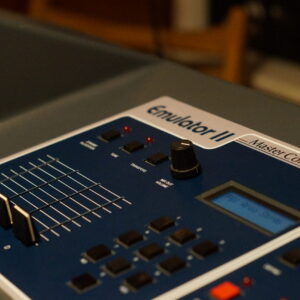 E-mu Emulator IIEIIFX · real-time FX OS for Emulator II / II+
49,99 €
EIIFX replaces the sampling page of OS 3.1 with a live effect. The input runs through the EII’s own anti-aliasing filter, its 8-bit companding converters and the SSM2045 filter that defines the Emulator II sound. The input path is separate from the outputs, so the effect can run 100 % wet.
Features
- Sample rate from 27.8 kHz down to 243 Hz on an exponential slider curve
- Anti-alias filter in front of the converter, 64 steps, freely adjustable
- SSM2045 cutoff and resonance on the clean and the effect channel, with smooth gliding between values
- Ring buffer delay in 16 steps from 0.9 ms to 1.1 s, plus freeze to loop the buffer
- All four front-panel sliders are mapped, everything else via MIDI CC
- Fast-loading disk: only the OS loads, no 30-second bank wait
Control
| Slider A / CC 74 | Anti-alias filter |
| Slider B / CC 76 | Sample rate |
| Slider C / CC 75 | Cutoff |
| Slider D / CC 80 | Resonance |
| CC 78 / CC 81 | Delay time / freeze |
Requirements
Emulator II or II+ with floppy drive or HxC / Gotek floppy emulator. Delivered as an HFE disk image. Back to normal: boot any regular EII disk.
Demo video
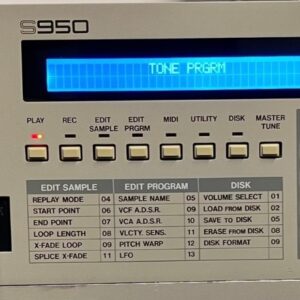 Akai S950SP MODE sampler OS · SP-12 grit on all 8 voices
24,99 €
SP MODE is an update for the S950’s own sampler OS. Normally the S950 closes its 36 dB anti-alias filter whenever a sample plays below its original pitch. SP MODE switches that filter tracking off on all 8 voices, so pitched-down samples keep their top end and alias the way an E-mu SP-12 does. Sampling, editing and disk functions work like on the stock OS.
Features
- SP MODE on the Master Tune page: filter tracking off on all 8 voices
- Switch it from the front panel or via MIDI CC 77, live while playing
- FILTER 0-99 covers the whole range, about 166 Hz to 20 kHz on a log curve. The stock OS does nothing below about 22 and above about 80
- Finer filter steps with a 16-bit divider instead of 8-bit
- Filter clock never drops below 8 kHz, which keeps clock bleed out of the audio
Control
| Master Tune page | SP MODE on/off with the knob |
| CC 77 | SP MODE on/off |
| FILTER 0-99 | About 166 Hz – 20 kHz |
Requirements
Akai S950 with floppy drive or Gotek, no EPROM swap. Delivered as a disk image. Back to normal: boot from the internal ROM. Because of the new filter curve, existing programs can sound different than on the stock OS.
Demo video
FAQ
What is a sampler OS mod?
An OS mod, also called custom firmware or a firmware hack, is a modified or newly written operating system that your sampler loads from floppy disk, the same way it loads its factory OS. Nothing inside the machine is changed, so there is no soldering and no EPROM swap.
Do I need a Gotek or HxC floppy emulator?
A floppy emulator is the easiest way: copy the image file to a USB stick or SD card and select it. With a real floppy drive you can write the image to a disk with a tool like Greaseweazle.
Can I go back to the factory OS?
Yes. The Emulator II and the S950 load the OS into RAM, so the next boot from a normal disk or from the S950’s internal ROM brings everything back.
Can I control the effects from my DAW?
Yes. EIIFX reads MIDI CC for anti-alias filter, sample rate, cutoff, resonance, delay and freeze. On the S950, SP MODE switches on and off with CC 77.
How do I use the Emulator II as an effect in a mix?
Patch an aux send from your mixer or audio interface into the sampler input and bring the output back on a return channel. Set the effect fully wet and blend it in with the return fader.
What do I get after buying?
A download with the disk image for your sampler and a short guide covering installation, controls and the way back to the stock OS.
Can a firmware mod damage my sampler?
Both mods run from RAM and change nothing permanently: switch off, boot a normal disk, and the sampler is back to stock. You install the mods at your own risk, see the legal notes below.
Is my sampler not on the list?
Work on more machines is in progress. If you own a vintage sampler and want an FX OS for it, get in touch.
Legal notes
Trademarks. Akai, S950, E-mu, Emulator, SP-12 and all other product and company names on this page are trademarks of their respective owners. They are used solely to identify the instruments the firmware is compatible with. TailOut Studios and these firmware mods are independent and not affiliated with, endorsed or sponsored by the manufacturers or current trademark owners of these instruments.
Use at your own risk. Installing and using firmware on vintage instruments is done at your own risk. Back up your disks, samples and settings before you start. The firmware is provided as described on this page; we give no guarantee that it works with every unit, revision or modification.
Liability. TailOut Studios is not liable for damage to instruments, disks or data, or for loss of value of vintage hardware, arising from the installation or use of the firmware, unless the damage was caused intentionally or by gross negligence. This does not limit liability for injury to life, body or health, liability under the German Product Liability Act, or any statutory consumer rights that cannot be excluded by law.